Address
304 North Cardinal St.
Dorchester Center, MA 02124
Work Hours
Monday to Friday: 7AM - 7PM
Weekend: 10AM - 5PM

Address
304 North Cardinal St.
Dorchester Center, MA 02124
Work Hours
Monday to Friday: 7AM - 7PM
Weekend: 10AM - 5PM


 ByLiz Q.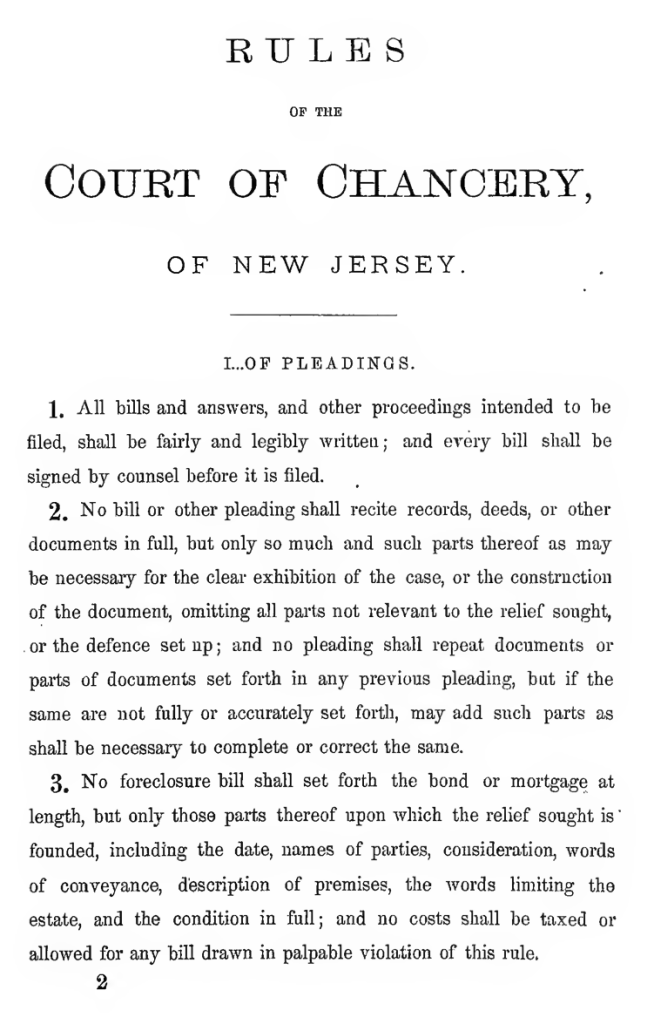
While adding some records to the library, I came across the source material from Nightrain’s equity case reference collection in the form of Precedents and Notes of Practice in the Court of Chancery (1872) Stacy G. Potts. I found this section particularly relevant to serve as a basis for our first blog post.
“No bill or other pleading shall recite records, deeds, or other documents in full, but only so much and such parts thereof as may be necessary for the clear exhibition of the case, or the construction of the document, omitting all parts not relevant to the relief sought, or the defence set up ; and no pleading shall repeat documents or parts of documents set forth in any previous pleading, but if the same are not fully or accurately set forth, may add such parts as shall be necessary to complete or correct the same.”
Precedents and Notes of Practice in the Court of Chancery (1872) Stacy G. Potts p.2
One of the inspirations for taking on the project of curating and indexing Christian Walter’s educational work on Equity and trusts in the form of New Trust Technology (NTT) was to actively shape the archive make his ideas clear and accessible to willing and open minds in order to help others understand the fundamental concepts in the shortest amount of time.
In the learning & development world, this is a metric called “Time to Competence,” which is the average amount of time spent for a learner to achieve the set of goals that defines competence, typically expressed in hours.
Walters started with this end in mind by by creating a “Top 40” list of his audio recordings, whereby investing the time in those audio recordings alone should theoretically result in the fastest (as in, least amount of invested hours) Time to Competence.
However, despite his intentions, the outcomes of later learners did not support this hypothesis in practice. Listening alone to the Top 40 audios alone in chronological order resulted in procedural errors and doctrinal misunderstandings that were only briefly or tangentially referenced. The Time to Competence started creeping up, frustrating learners to the point where many would abandon the study entirely due to failure in application or fundamental confusion.
The format of the original audio recordings was generally split into two halves: 1) A lecture or reading segment and 2) A question and answer period. However, often the two did not relate, or the questions were off-topic, irrelevant, or deprecated.
It seems like a sound principle that “Equity does not waste another’s time.” In fact, this can indeed be inferred from the equitable maxims.
1. He who seeks equity must do equity. If you wish to be treated fairly, you must do the same to others.
2. Delay defeats equity. Too many words is a form of delay. Getting to the point quickly is equitable.
3. Equity acts in personam. Equity is about relationships between those with a conscience. It deals with rights (of the beneficiaries) and duties (of the trustees to the beneficiaries, set up by the grantor). Unlike corporations, people have a conscience and are inherently limited by a finite number of breaths.
Our approach to learning Christian Walters’ material is a fork of the CW_Master archive with:
1. A focus on the Time to Competency metric;
2.The creation of a usable index based on topics, taxonomies, and relations;
3. The use of diverse forms of media to convey concepts;
4. An in personam focus of creating metaphors, hypothetical scenarios, and applications for the learner to grasp and apply the knowledge of Equity and trusts, as Christian Walters intended; and
5. Refinement and improvement.
Take NOTICE and ACKNOWLEDGEMENT with agreement that this show and/or documents is PRIVATE, and not to be construed or relied upon as being legal advice for any individual legal situation or employed for making legal decisions, and you will not use any of this information for making a legal decision or performing a legal procedure, and is not a substitute for legal advice and/or guidance by a licensed attorney. This private show and/or documents are for academic, informational purposes only to be used at your own risk, without liability to Edifie.co or its sub-trusts (“the Trust”). By accessing or reviewing this show, or using the documents therein, you understand with agreement that, with all rights reserved, without prejudice, The Trust is not an attorney licensed to practice law in the State of Florida, or any other State, and has not given legal advice, or accepted fees for legal advice, provided no assistance, advising, or guidance of any kind, for use by non-attorneys or pro se parties in the preparation or use of the therein reference, and has no interest in any issue referenced to it therein, and is not a party to this, or any action arising from, and is only acting as an authorized capacity as liaisons to communications between the parties. By reading and/or using this information you acquire knowledge, and agree that you are not a client of The Trust. These documents and show recordings are incomplete and void without this NOTICE AGREEMENT being attached herein by reference, and a breach of this agreement. Upon breach of this agreement, the breaching party becomes liable for ADMIRALTY COMMERCIAL DAMAGES of $100 million dollars per stultification or impairment per The Trust’s discretion. Thank you for your understanding.